EV Charging Basics
Charging an Electric vehicle (EV) is the heart of the electric mobility revolution. Understanding the fundamentals of EV charging is crucial for EV owners and enthusiasts alike. From different charging modes to emerging technologies, the world of EV charging is dynamic and diverse, offering a range of options to cater to the various needs and scenarios. In this exploration of EV charging basics, we will delve into the key aspects that power the electric driving experience.
So, the question arises, will your next vehicle be an electric one? Read on to find out more benefits of an electric vehicle
Electric Vehicle Battery (Traction Battery)
It is a battery used to power the electric motors of an EV, HEV, or PHEV. The EV Battery consists of multiple cells in parallel and series configurations.
On-Board Charger
The onboard charger is present in the vehicle and converts AC power from the charging station or electrical socket to DC power to charge the EV battery.
Electric vehicle supply equipment (EV Charging Stations)
A Device which delivers electrical energy to charge an EV or PHEV.
EVSE Connector
The EVSE connector is a plug that connects to an EV or PHEV on one end and the EVSE on the other end. The electrical power and communication between the charging station and EV are part of this connector.
Charging Systems – Classification
The charging system can be broadly classified into two primary categories:
- Detachable battery chargers: Only battery is required at the charging station
- Electric vehicle chargers:Vehicle is required at charging station
Detachable battery chargers come with a domestic AC adapter and provide the convenience of swappable battery charging stations. In contrast, electric vehicle chargers necessitate the presence of the entire vehicle at the charging station for the charging process to commence.
Additionally, the electric vehicle chargers, can be categories into three types:
- On-board Chargers: These chargers employ AC input through a cable.
- Off-board Chargers: These chargers rely on DC input, typically facilitated through devices like a gun, pantograph, or overhead cables.
- Run-time Chargers: This category offers wireless charging options while the vehicle is in motion, such as overhead cables or on-road systems.
EV Plug-in Charging Modes
Electric vehicles have evolved significantly to accommodate the diverse needs and requirements of EV owners and so have the charging methods to cater to the evolving needs. These plug-in charging modes not only reflect technological advancements but also address practical considerations, making the transition to electric mobility smoother and more accessible for all. Let’s dive deeper into these modes:
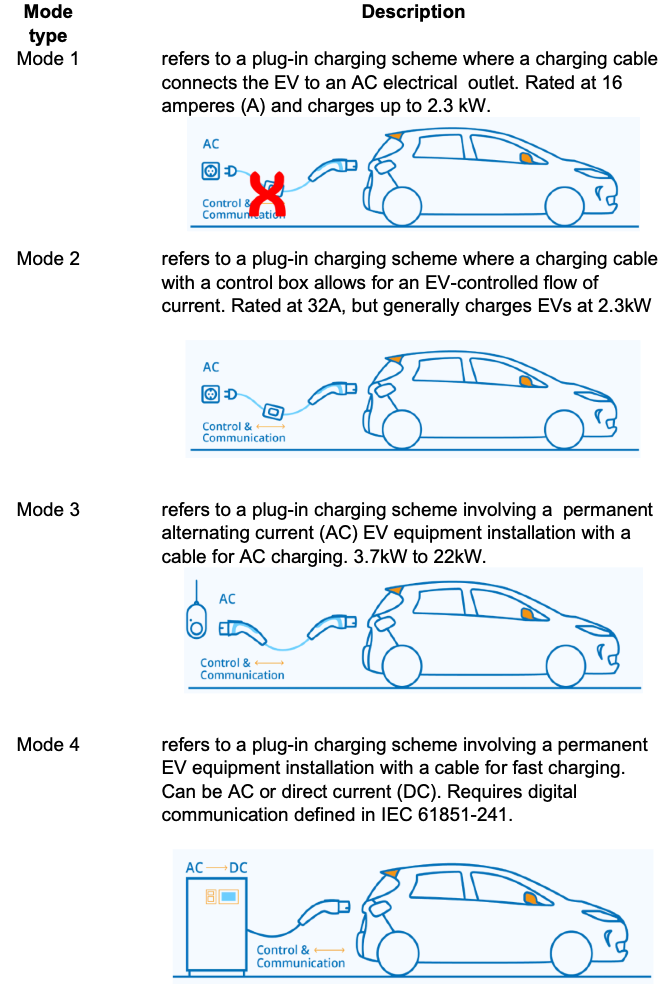
Mode 1: It represents direct AC charging from a non-dedicated socket, which can deliver either low-power single or three-phase AC. In this mode, there’s typically no charge control and protection integrated into the charging socket and cable. Moreover, communication between the vehicle and the grid is absent. Mode 1 charging is commonly utilized for light EVs, particularly for home charging.
Mode 2: This also involves direct AC charging from a non-dedicated socket, offering both single and three-phase AC charging capabilities. What sets Mode 2 apart is the presence of an in-cable control protection device (IC-CPD) within the charging cable. This device includes crucial control and safety features, enhancing the charging process.
Mode 3: This introduces AC supply from a dedicated EV supply outlet or connector, supporting both single and three-phase AC charging. Unlike the previous modes, Mode 3 comes with extended safety and control functionalities integrated into the charging station itself. Furthermore, this mode enables communication between the vehicle and the charging station, facilitating more sophisticated charging processes.
Mode 4: This mode marks a transition to DC charging from an external charger. It incorporates advanced safety and control functionalities and features a fixed charging cable directly connected to the charging station. Like Mode 3, communication between the vehicle and the charging station is established, enabling seamless interaction for efficient charging.
As mentioned, Mode 1, 2, and 3 operate on AC, while Mode 4 operates on DC, offering a diverse range of charging solutions to cater to various EV charging needs and scenarios.